
Isaac Newton was, by his own school’s account, an unremarkable student. Then he went home for two years during a plague outbreak at Cambridge, thought hard about the physical world around him, and came back with the foundations of calculus and a theory of gravity that explains, in one formula, why an apple falls and why planets stay in orbit. NASA’s own Astronomy Picture of the Day archive still uses exactly this story to introduce Newton to the public, because it captures something true about how science actually progresses: not through steady institutional output, but through individual curiosity given enough room to work.
That’s the throughline connecting the scientists in this article. Each one changed how humanity understood something fundamental, and each one got there through a mix of stubborn curiosity, careful observation, and, in more than one case, real personal risk.
Galileo Galilei: The Man Who Looked Up and Paid for It
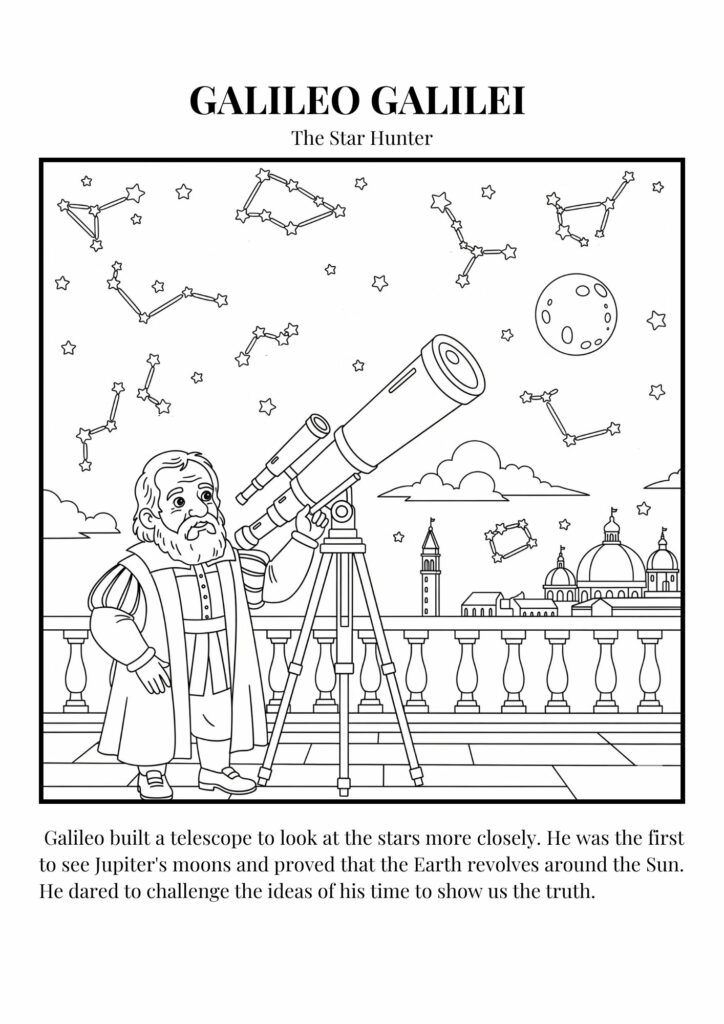
Galileo didn’t invent the telescope, but he was among the first to point an improved version of one at the sky and take it seriously as a scientific instrument. What he saw upended the accepted picture of the universe: mountains on the Moon, moons orbiting Jupiter, and evidence supporting the idea that Earth orbits the Sun rather than the other way around.
That last point put him in direct conflict with the Catholic Church, which held to the earlier, Earth-centered model of the universe. Galileo was tried and forced to recant his support for a Sun-centered solar system, and he spent the last years of his life under house arrest. He kept working anyway. His studies on motion, on how objects accelerate and fall, laid groundwork that Isaac Newton would build on decades later.
Did You Know? NASA named an entire mission to Jupiter, the Galileo probe, after him, a nod to how directly his observations of Jupiter’s moons still shape modern space exploration.
Isaac Newton: Gravity, Light, and a Needle in the Eye
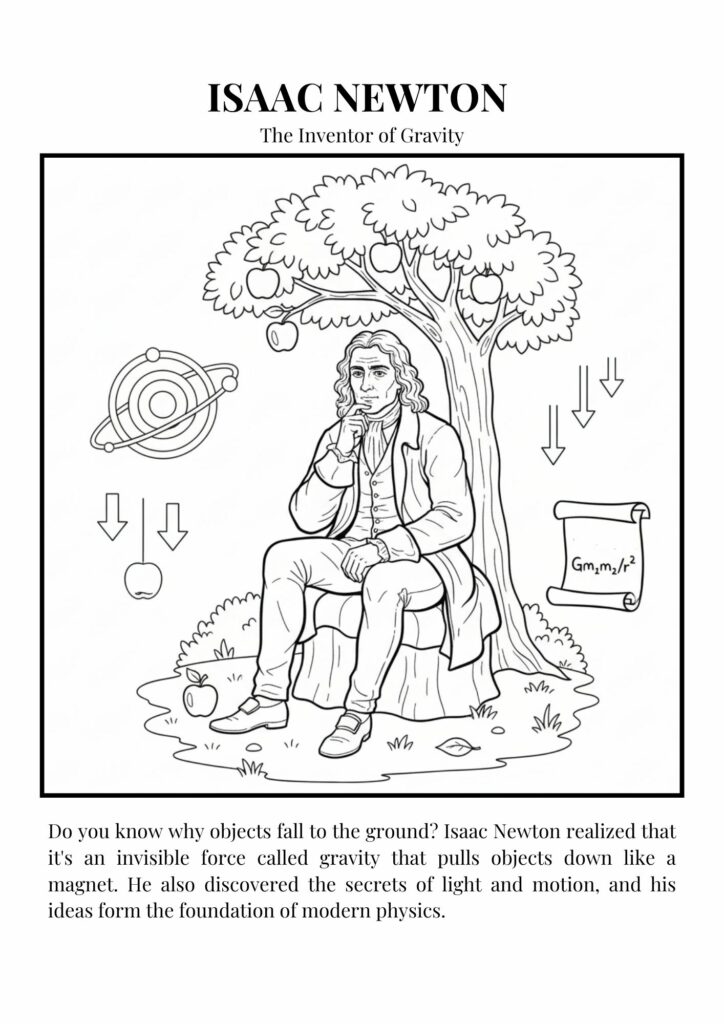
Newton’s law of universal gravitation and his three laws of motion are still the basic toolkit used to calculate how spacecraft move through the solar system today. He also did foundational work on optics and invented a new branch of mathematics, calculus, largely to solve the physics problems he was working on.
Newton was also famously eccentric in his methods. Among the stranger, well-documented episodes from his own notes: he once inserted a blunt needle between his eye and the bone behind it, pressing gently, to study how pressure on the eye affected the visual images he perceived. He recorded the results and, remarkably, suffered no lasting harm.
Marie Curie: Two Nobel Prizes and a Legacy That’s Still Radioactive
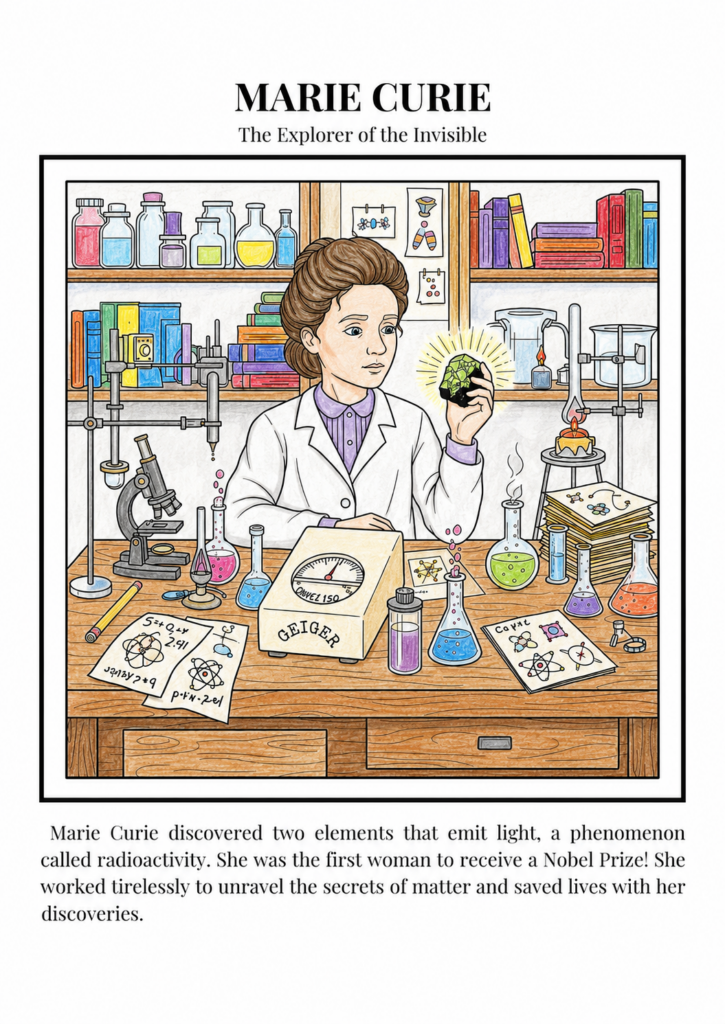
Marie Curie remains the only person, of any gender, to win Nobel Prizes in two different sciences, physics and chemistry. Working alongside her husband Pierre, she discovered the phenomenon of radioactivity and identified two new elements, polonium and radium.
During World War I, Curie personally organized mobile X-ray units, sometimes called “Little Curies,” and helped train technicians so wounded soldiers near the front lines could get X-rays without being transported to distant hospitals first.
The cost of that pioneering work was real. Curie died from aplastic anemia, a blood disorder almost certainly caused by prolonged exposure to radiation she didn’t yet know was dangerous. Her laboratory notebooks are kept in lead-lined boxes today because they remain radioactive over a century later.
Did You Know? Curie’s 1911 Nobel Prize in Chemistry made her the first person to win a second Nobel Prize altogether, not just the first woman to do so.
Ada Lovelace: Writing Instructions for a Machine That Didn’t Exist Yet
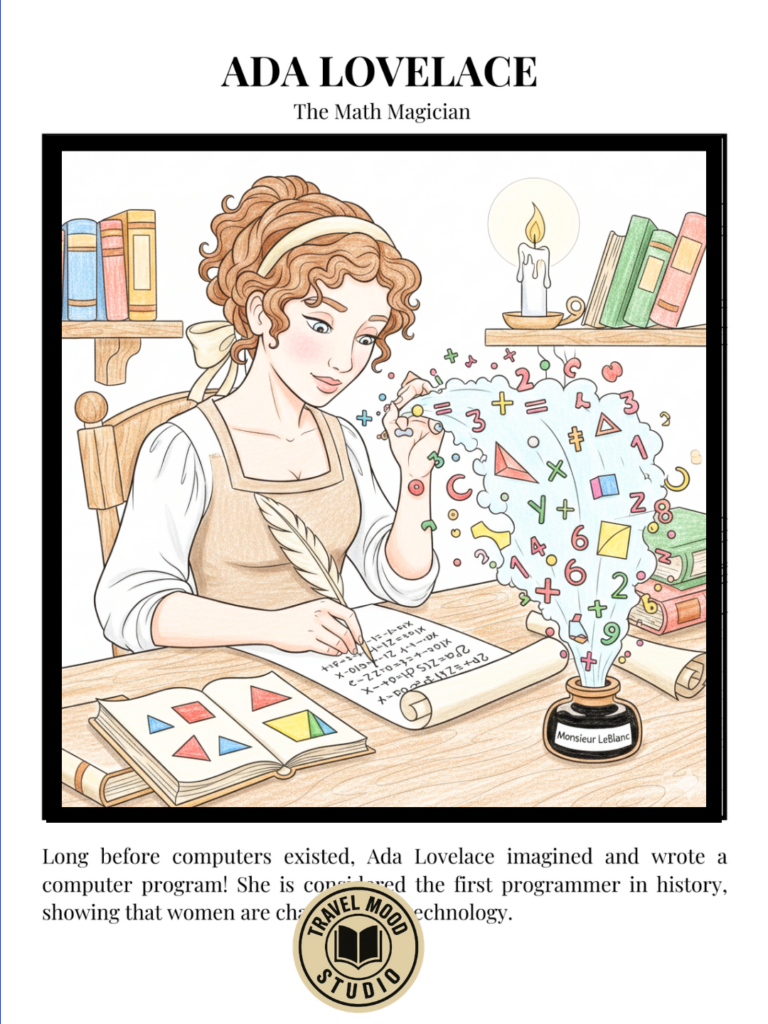
Ada Lovelace worked with inventor Charles Babbage on his proposed Analytical Engine, a mechanical general-purpose computer that was never fully built in her lifetime. In her notes on the machine, published in 1843, Lovelace wrote what’s now recognized as the first published algorithm intended to be processed by a machine, essentially the first computer program, more than a century before electronic computers existed.
She’s remembered today as the world’s first computer programmer, and her notes also included an early, remarkably prescient observation: that such a machine might one day be used for more than just numbers, an idea that anticipated modern computing far beyond simple calculation.
A Common Thread: Careful Observation Over Assumption
Each of these scientists shares something beyond raw intelligence: a willingness to trust careful, repeated observation over inherited assumption, even when that meant challenging the most powerful institutions or accepted beliefs of their time. Galileo challenged the Church. Curie worked in a field literally invisible to the naked eye, guided only by careful measurement. Lovelace imagined uses for a machine that had never been demonstrated to do anything at all.
That habit of mind, trusting evidence over assumption, is really what “the scientific method” means in practice, and it’s a mindset kids can start practicing early, long before they touch a single formula.
Bringing These Stories Into a Homeschool or Classroom Unit
Biographical science content works best for kids when it’s paired with something visual and something hands-on. A portrait to study while reading, or a simple related experiment, turns an abstract historical fact (“Newton discovered gravity in the 1660s”) into something a child has actually seen or tried themselves.
This is exactly the approach behind our Great Minds of Science collection: each scientist gets an illustrated portrait alongside a short, verified account of their key discovery, giving kids a visual anchor for names and discoveries that can otherwise blur together. It pairs naturally with a simple activity like a bottle-drop gravity test for Newton and Galileo, or a magnet-and-compass demonstration for anyone studying electromagnetism later in a science sequence.
If your unit on great minds extends into everyday inventions, our 50 Inventions That Changed the World collection and its companion article on [the inventions that changed the world] pick up where individual scientist biographies leave off, tracing how specific discoveries turned into the tools we use daily.
A Simple Activity to Try This Week
Have your child pick one scientist from this article and, without looking anything up, guess what tools that person might have used to make their discovery (a telescope, a notebook, a magnifying glass). Then check their guess against the real story. This works particularly well for Galileo and Newton, since both worked with surprisingly simple, sometimes homemade equipment, a good reminder for kids that major discoveries don’t always require expensive tools, just careful attention.
Why These Stories Still Matter
None of these four scientists worked in isolation, and none of them got everything right on the first try. Galileo’s observations were incomplete by modern standards; Newton’s physics was eventually refined by Einstein; even Curie’s early research didn’t yet account for radiation’s dangers. That’s not a weakness in their stories, it’s the most useful lesson in them: science progresses through people willing to be wrong in public, correct course, and keep looking closely anyway.
Go Further
- Great Minds of Science : illustrated portraits and verified biographies of scientists and inventors, from Galileo to modern discoveries.
- 50 Inventions That Changed the World : a natural next step once kids have met the scientists behind the discoveries; this collection traces how those breakthroughs became the everyday tools and technologies we use now.
- Pair with our article on [the inventions that changed the world] for a unit connecting individual scientists to their lasting inventions (coming soon)
Sources
- NASA Astronomy Picture of the Day, Isaac Newton Explains the Solar System
- Nobel Prize, Marie Curie biographical information
- Biography.com, Famous Scientists Who Changed the World
- Discover Magazine, Famous Scientists Who Changed the World Through Their Discoveries