
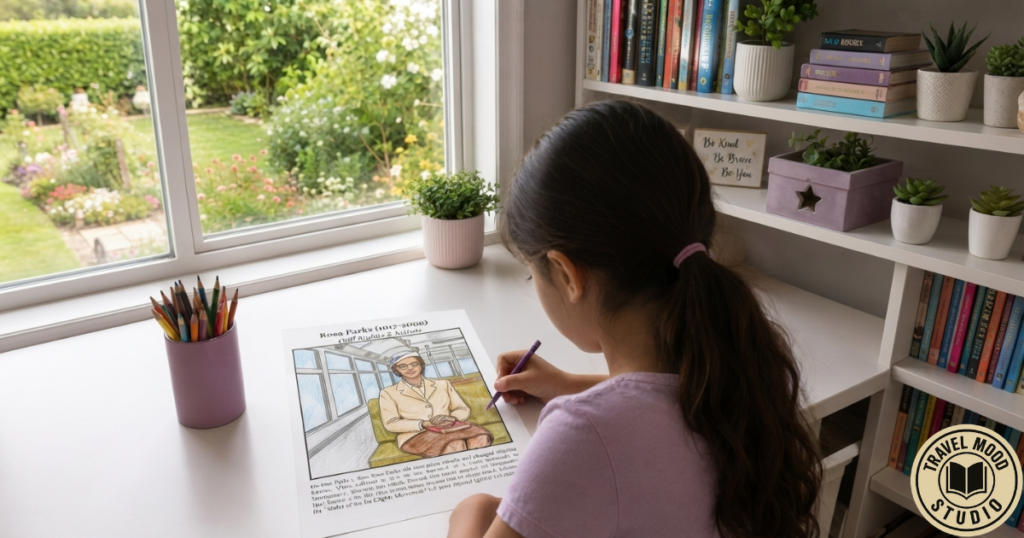
History often becomes easier to understand when we stop thinking about dates and start thinking about people.
Ask a child what they remember after a history lesson a few weeks later, and they are much more likely to mention an astronaut who walked on the Moon, a scientist who made an important discovery, or a courageous woman who changed society than the exact year when an event took place. Children naturally connect with stories because stories have characters, challenges and emotions. They help the past feel real.
This is one reason why historical figures coloring books for kids have become such valuable educational resources for families, homeschoolers and teachers. Instead of simply reading about famous people, children discover their stories while creating something with their own hands. Reading, observing and coloring become part of the same learning experience.
At Travel Mood Studio, we believe that curiosity grows when children enjoy learning. A well-designed educational coloring book does much more than keep young learners busy. It invites them to slow down, look carefully, ask questions and become genuinely interested in the people who shaped our world.
Why biographies are such a powerful way to teach history
History is sometimes introduced through long timelines or lists of important events. While those approaches have their place, they can be difficult for younger learners to connect with.
Biographies offer a different entry point. Instead of beginning with an event, they begin with a person.
A child may not remember the year when the first successful powered flight took place, but they are much more likely to remember two brothers who spent years experimenting with flying machines in a bicycle shop. The story gives meaning to the historical fact.
Psychologist Jerome Bruner argued that human beings naturally make sense of the world through narratives. Stories help us organize information, understand cause and effect, and remember what we have learned. In education, this means that historical figures often provide memorable anchors for larger historical events.
Think about Marie Curie. Her story is not simply about radioactivity. It is also about perseverance, scientific curiosity and determination. Learning about Martin Luther King Jr. is not only an opportunity to discuss the American civil rights movement. It is also a chance to talk about courage, equality and peaceful action.
Children rarely remember history because someone asked them to memorize it. They remember it because a person’s story stayed with them.
Learning becomes richer when children participate
Reading is an essential part of learning, but children often understand new ideas more deeply when they actively engage with them.
Coloring may appear to be a simple artistic activity, yet it encourages children to spend more time looking at an illustration, noticing details and reflecting on what they have just read. Instead of quickly turning the page, they remain focused on the same historical figure for several minutes.
Research in cognitive psychology offers an interesting explanation for this. Allan Paivio’s Dual Coding Theory suggests that people tend to remember information more easily when words and images reinforce one another. Reading a short biography while studying and coloring a portrait creates two complementary ways of processing the same information.
Of course, coloring alone does not teach history. What makes the difference is the combination of reading, conversation and creativity.
A short discussion before or after coloring often leads to thoughtful questions.
Why was this invention so important?
How did this explorer change the way people understood the world?
Would I have made the same decision in that situation?
These conversations encourage children to think beyond simple facts and begin developing historical understanding.
Which historical figures capture children’s imagination?
Some biographies seem to spark curiosity almost immediately.
Scientists are among the most popular because children naturally want to know how things work. Isaac Newton, Galileo Galilei, Albert Einstein, Katherine Johnson and Nikola Tesla all remind young readers that many great discoveries began with simple questions.
Explorers are equally fascinating. Their journeys introduce geography, different cultures and remarkable adventures. Whether crossing oceans, climbing mountains or travelling into space, explorers encourage children to imagine places beyond their everyday experience.
Artists and inventors show another side of history. Leonardo da Vinci combined science with creativity. Louis Braille transformed millions of lives through a writing system that is still used today. The Wright brothers proved that determination and experimentation can change the future.
Many children are also inspired by individuals who stood up for others. Rosa Parks, Nelson Mandela, Harriet Tubman and Malala Yousafzai remind us that history is not shaped only by discoveries and inventions. Compassion, courage and perseverance can also leave a lasting legacy.
Presenting this wide variety of historical figures helps children understand that there is no single path to making a difference. Some changed the world through science, others through art, leadership, exploration or acts of extraordinary bravery.
Discover history through the people who shaped it
One of the goals behind every Travel Mood Studio book is to make history approachable without oversimplifying it.
Instead of overwhelming children with long chapters, each page introduces one historical figure through an original illustration accompanied by a concise, carefully researched text. The objective is not to replace a history textbook but to encourage curiosity and create opportunities for further exploration.
One of the collections that best reflects this philosophy is America’s Journey.
Rather than presenting American history as a succession of dates and political events, the book introduces forty remarkable individuals whose ideas, discoveries and actions helped shape the United States. Children meet explorers, inventors, presidents, scientists, civil rights leaders, artists, pioneers and astronauts. As they move from one biography to the next, they gradually build a broader understanding of American history through the lives of the people who influenced it.
For many children, this approach feels far more natural than memorizing a timeline. History becomes a collection of human stories, each connected to the next.
More Than Coloring Pages: Educational Resources Designed to Spark Curiosity
Every educational coloring book created by Travel Mood Studio begins with the same question: What do we want children to remember years from now?
The answer is never a list of dates.
Instead, we hope they will remember that Marie Curie never stopped asking questions. That Neil Armstrong took humanity’s first steps on the Moon after years of preparation. That Harriet Tubman risked her own safety to help others find freedom. That Leonardo da Vinci refused to limit his curiosity to a single subject.
These are the kinds of stories that stay with children because they are deeply human.
America’s Journey
If your child is beginning to explore the history of the United States, America’s Journey offers an engaging introduction through forty remarkable individuals.

Rather than following a traditional chronological timeline, the book introduces the people whose ideas, achievements and courage helped shape the nation. Young readers discover Indigenous leaders, explorers, inventors, scientists, presidents, civil rights pioneers, artists, entrepreneurs and astronauts, each presented through an illustrated portrait and a short, accessible biography.
This approach allows children to understand that history is built by ordinary and extraordinary people making decisions that can have lasting consequences. As each biography connects with the next, children gradually build a broader picture of American history without feeling overwhelmed.
For a closer look at how the nation’s institutions work, see our guide on how to teach US civics to kids.
Women of History
History books have not always given women the place they deserve.
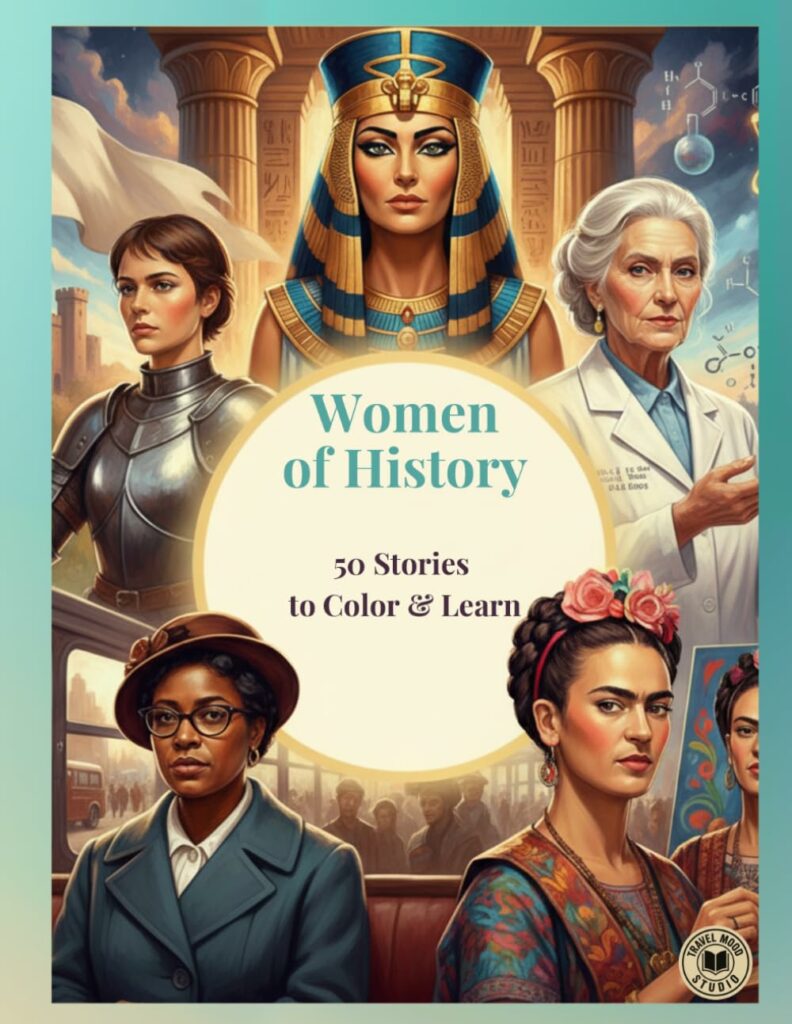
Women of History introduces children to fifty women whose discoveries, creativity, leadership and determination changed the world. Scientists, artists, explorers, writers, activists and political leaders appear side by side, showing that remarkable achievements have always come from many different backgrounds and cultures.
The book naturally encourages conversations about perseverance, equality and the many ways people can make a positive difference.
We take a closer look at some of these figures in Women Who Shaped History (That We Don’t Talk About Enough).
Great Minds of Science
Many children love asking “Why?”
That simple question lies behind every scientific discovery.
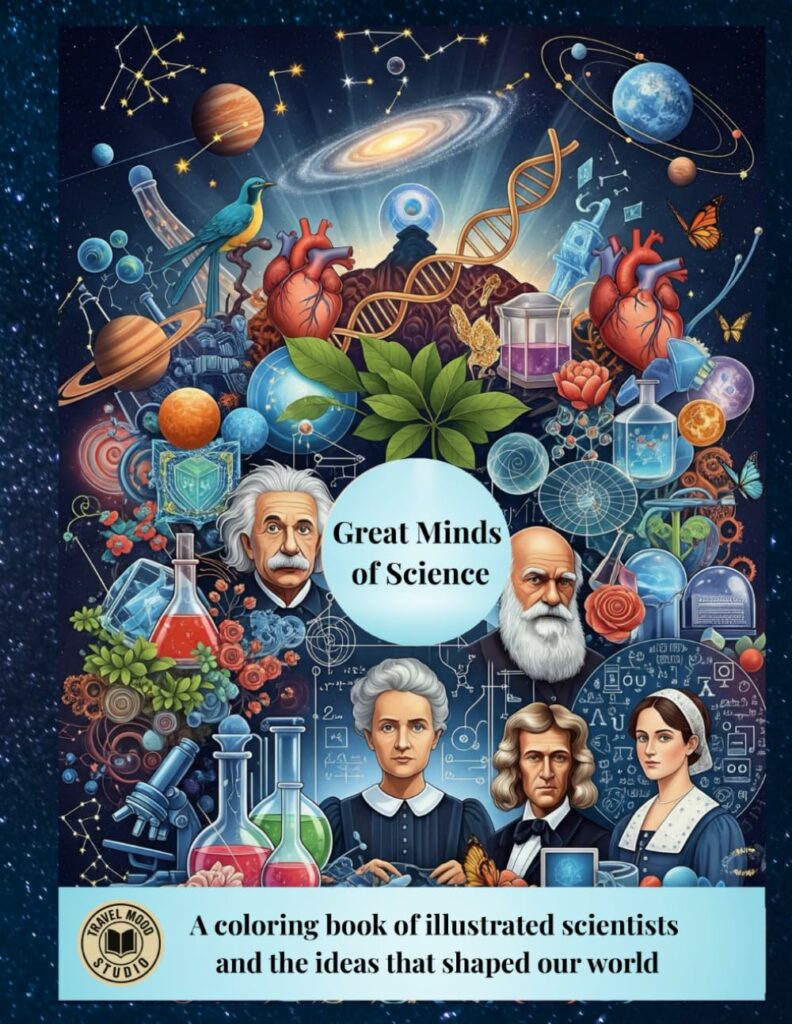
Great Minds of Science introduces young readers to the men and women whose curiosity transformed our understanding of mathematics, medicine, astronomy, engineering, chemistry and physics. Instead of presenting science as a collection of formulas, the book highlights the people behind the discoveries and the challenges they overcame along the way.
For children who enjoy both history and science, these biographies often become the starting point for deeper exploration.
Read more in Great Minds in Science Who Changed the World.
Looking Beyond History Books
Not every important story comes from recorded history.
Ancient myths have shaped literature, art and culture for thousands of years, and understanding these stories helps children make sense of countless references they will encounter throughout their education.
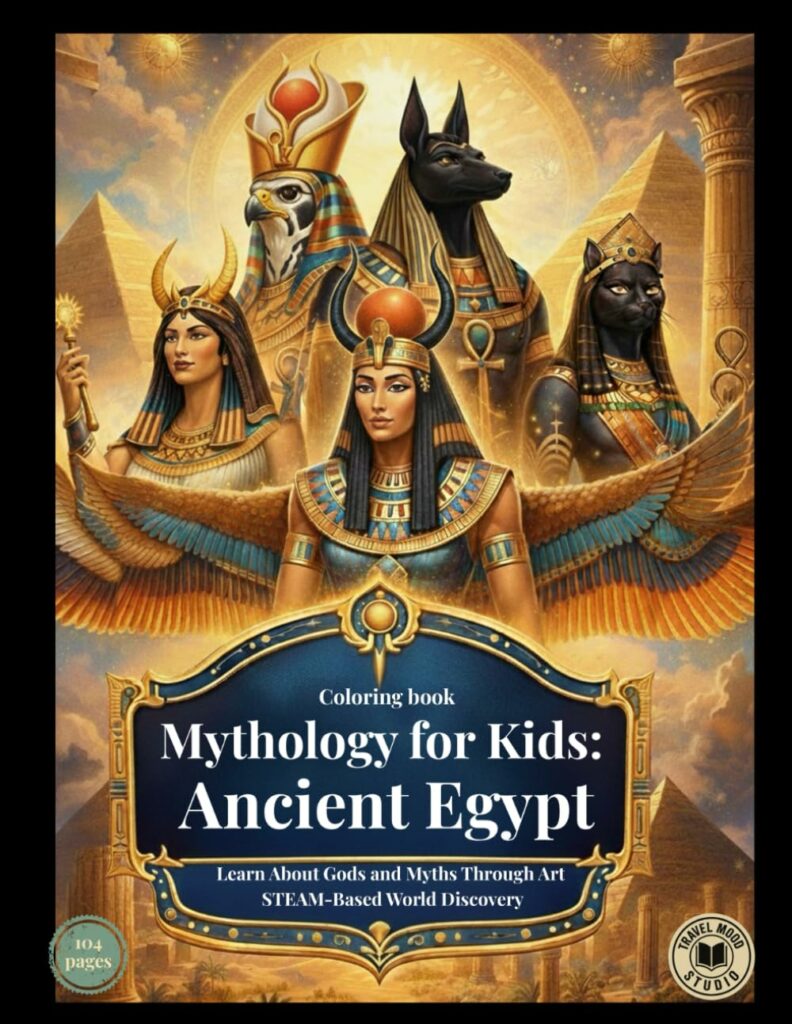
Our collections on Greek Mythology, Egyptian Mythology and Norse Mythology introduce young readers to the characters, symbols and legends that have inspired artists, writers and historians for centuries. Although these figures are legendary rather than historical, they offer valuable insight into the beliefs and values of the civilizations that created them.
Helping Children Get Even More From Historical Figures Coloring Books
One of the advantages of historical figures coloring books for kids is their flexibility. They can be used in many different ways depending on the child’s age, interests and learning environment.
In a classroom, a teacher might use a biography as the starting point for a discussion before moving on to a larger historical topic. At home, parents often discover that a short coloring session naturally leads to questions that might never have appeared during a traditional lesson.
A few simple habits can make these activities even more meaningful.
Read the biography together before picking up the coloring pencils. Even confident readers enjoy sharing discoveries with an adult, and discussing unfamiliar words helps strengthen vocabulary.
Encourage curiosity rather than memorization. Questions such as “What surprised you most?” or “Why do you think this person is still remembered today?” invite children to reflect instead of searching for the “right” answer.
Look for connections with everyday life. Children enjoy realizing that many things they use every day, from electricity and airplanes to computers and vaccines, exist because someone once imagined a better solution to a problem.
Finally, celebrate what they have learned. Displaying finished portraits on a wall, creating a binder of completed pages or revisiting favorite historical figures throughout the year reminds children how much knowledge they have already gained.
Frequently Asked Questions
What age are historical figures coloring books for kids designed for?
Most children begin to enjoy biography-based coloring books between the ages of 8 and 12, when they are able to read short informational texts independently. Younger children can also enjoy them with the support of an adult who reads the biographies aloud.
Are historical figures coloring books suitable for homeschooling?
Yes. Many homeschooling families appreciate resources that combine reading, art and history in a single activity. Coloring books can complement a history curriculum while encouraging independent learning and meaningful discussion.
Can teachers use these books in the classroom?
Absolutely. Teachers often use biography coloring pages during history lessons, literacy activities, early finisher work or cross-curricular projects that combine social studies, reading and visual arts.
Do children really learn while coloring?
Coloring is not a substitute for teaching, but it can become an effective learning activity when paired with accurate information and thoughtful discussion. Educational research suggests that combining words and images helps many learners organise and remember new information more effectively.
Final Thoughts
Helping children appreciate history is not about asking them to memorize every date or every historical event. It is about helping them understand that the world we live in today was shaped by real people who faced challenges, solved problems, defended their beliefs and imagined new possibilities.
That is why historical figures coloring books for kids can be such valuable educational resources. They encourage children to slow down, observe carefully, read thoughtfully and connect with stories that have stood the test of time.
At Travel Mood Studio, our goal is simple. We want children to discover that history is not distant or complicated. It is a collection of human stories filled with curiosity, courage, creativity and hope. If a single biography inspires a child to ask one more question, open another book or look at the world a little differently, then that page has already achieved something meaningful.
References
Bruner, J. (1991). The Narrative Construction of Reality.
Page officielle de l’article (Critical Inquiry, University of Chicago Press) :
https://doi.org/10.1086/448619
Paivio, A. (1986). Mental Representations: A Dual Coding Approach.
Page officielle Oxford Academic (Oxford University Press) :
https://doi.org/10.1093/acprof:oso/9780195066661.001.0001
National Council for the Social Studies — C3 Framework
Page officielle NCSS :
https://www.socialstudies.org/c3
(PDF du framework complet, hébergé par NCSS : https://www.socialstudies.org/sites/default/files/c3/C3-Framework-for-Social-Studies.pdf)
American Historical Association — Teaching and Learning Resources
Page officielle AHA :
https://www.historians.org/teaching-learning/
Education Endowment Foundation — Teaching and Learning Toolkit
Page officielle EEF :
https://educationendowmentfoundation.org.uk/education-evidence/teaching-learning-toolkit
Further readings:
Bruner – narrative et apprentissage (accessible, gratuit) :
https://www.simplypsychology.org/bruner.html
Paivio – Dual Coding Theory (accessible, gratuit) :
https://www.instructionaldesign.org/theories/dual-coding/