
You bought the timeline poster in August. By October it’s still rolled up in the closet, and the “history curriculum” has quietly turned into whatever chapter comes next in the textbook.
If that sounds familiar, you’re not doing anything wrong. Most history curricula are built to be covered, not remembered. And covering ground is a very different goal from building a mental map of the past that a child can actually recall five years later.
Planning an annual history curriculum around visual resources, images, timelines, portraits, maps, primary sources, changes what you’re optimizing for. Instead of asking “did we get through the chapter,” you start asking “does my child have a picture in their head of this person or event.” That single shift makes planning easier, not harder, because visuals give you natural checkpoints for the whole year.
Here’s how to actually build that plan, from the framework down to the month-by-month sketch.
Start With a Framework, Not a Textbook
Before choosing a single book or resource, it helps to know what a complete social studies education is supposed to cover. The National Council for the Social Studies, the main professional organization for the field in the United States, organizes the discipline around ten themes: culture, time and continuity, people and environments, individual development and identity, institutions, power and governance, production and consumption, science and technology, global connections, and civic ideals and practices.
You don’t need to hit all ten themes with equal weight every year. But keeping them in view stops a homeschool or classroom year from becoming “whatever we found on Pinterest.” A year built around ancient Egypt, medieval Europe, and the American Revolution can easily touch culture, institutions, and governance without a single worksheet, as long as you’re deliberate about it.
Did You Know? The NCSS first published national curriculum standards in 1994, and the framework has been revised since then to stay current with research on how children actually learn social studies content, not just memorize it.
Choose Your Backbone: Chronological, Thematic, or Regional
Every history plan needs a spine. The three most common approaches:
- Chronological – moving in time order, often across a multi-year cycle (ancients, then medieval, then early modern, then modern). This is the most common model in classical and Charlotte Mason-influenced homeschools.
- Thematic – organizing around big ideas (inventions, exploration, government, conflict) and pulling examples from any era to illustrate them.
- Regional – studying one part of the world in depth (a country, a continent) before moving to the next.
For children aged 8 to 12, a hybrid often works best: a loose chronological spine for the year, with thematic detours whenever a topic naturally connects to something your child is already curious about. If your fourth grader is obsessed with mythology, let ancient Greece or Egypt anchor the fall term instead of forcing a strict calendar order.
Why Visual Resources Aren’t Just “Extra”
Here’s the part that gets skipped in most curriculum guides: the visual layer isn’t decoration on top of “real” history content. It’s often how young children build their first working model of the past.
The Library of Congress, which digitizes and hosts millions of primary source materials for classroom use, notes that posters, prints, drawings, and photographs let students explore history through the actual visual media of the period being studied, not just text describing it. Their teaching guidance explicitly encourages using a wider range of formats than the photographs and transcribed documents most teachers default to.
This matters even more for elementary-age learners who haven’t yet built strong text-based study habits. A child who has colored a careful portrait of Cleopatra or traced the layout of the Roman Forum has done something a paragraph of text can’t replicate: they’ve spent ten or fifteen focused minutes looking closely at details, which is exactly the kind of sustained attention that turns a fact into a memory.
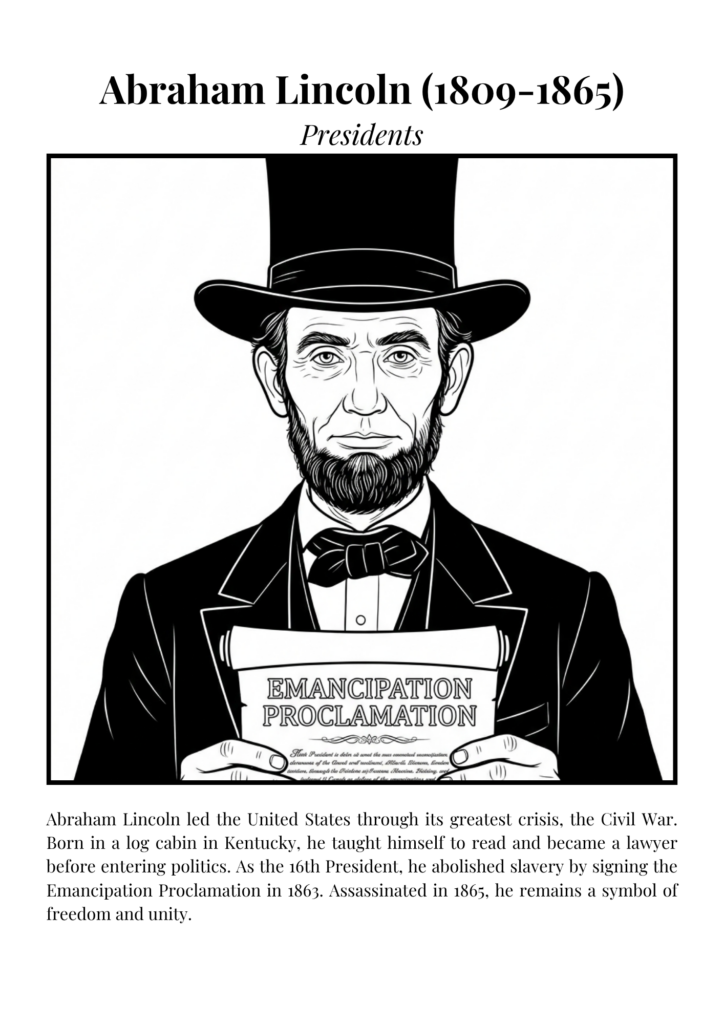
This is one of the reasons we built our America’s Journey or Women of History collections the way we did: each figure gets a full-page illustrated portrait paired with a short, verified biographical text, so a child colors while they read instead of reading in isolation. If you’re mapping out a year on historical figures, a resource like this gives you a built-in visual anchor for each person you cover, without you having to source and print your own images for thirty different historical figures.
(For more on why this pairing of image and text works from a learning-science standpoint, see our article on dual coding theory and why images help kids remember what they read.)
Building the Actual Plan: A Month-by-Month Sketch
Here’s a workable structure for a 9- or 10-month school year, aimed at ages 8 to 12, using a loose chronological spine with visual anchors built in.
Fall (September–November): Ancient Civilizations
- September: Ancient Egypt : daily life, the Nile, and Egyptian mythology. Pair readings with illustrated portraits of gods and pharaohs.
- October: Ancient Greece : city-states, daily life, and Greek mythology (a natural point to introduce the Olympian gods).
- November: Rome : the Republic, engineering, and how Roman institutions still echo in modern government.
Winter (December–February): Medieval and Early Modern World
- December: A lighter month — focus on world cultures and geography rather than a single narrative arc.
- January: The medieval world — trade routes, castles, and the spread of ideas across regions.
- February: Great thinkers and inventors — this is a natural point to introduce scientists and inventors whose work reshaped how people understood the world.
Spring (March–May): The Americas and Modern History
- March: Indigenous peoples of the Americas, exploration, and early colonization.
- April: The American Revolution and the founding of US institutions : how laws are made, how government is structured.
- May: Women and lesser-known figures across history : a good closing unit, since by this point kids have the historical context to appreciate why these stories were often left out of the standard narrative.
Notice that this outline doesn’t require you to buy an entirely new curriculum. It requires you to slot in visual, hands-on resources at the moments where a textbook alone would otherwise ask a nine-year-old to absorb a wall of names and dates.
Did You Know? Teaching with Primary Sources, a Library of Congress program, offers ready-made “inquiry kits” built around five primary sources and a guiding question for a specific historical topic, designed so a teacher or parent doesn’t have to build a lesson from scratch.
A Concrete Activity to Try This Week
Pick one historical figure your child will study this year. Before you tell them anything about that person, ask them to draw or color a “guess” portrait based only on the person’s title or role (a queen, an inventor, a general). Then show them a real portrait or illustration and compare. This short exercise does two things at once: it surfaces what your child already assumes about the past, and it makes the real image far more memorable because it’s being compared against their own prediction.
Keeping the Plan Alive Past October
The honest truth is that no curriculum plan survives contact with a real school year unchanged. Sick days happen, some units run long, some fall flat. The visual-anchor approach is forgiving here: because each month has a clear image-and-figure focus rather than a rigid page count, you can compress or stretch a unit without losing the throughline. If Rome only gets two weeks instead of a month this year, your child still walks away with the portraits, the map, and the story, just at a faster pace.
Plan loosely, anchor visually, and let curiosity extend the units that catch fire. That’s a plan that survives to June.
Go Further
If you’re building out a year like the one above, these Travel Mood Studio titles map directly onto the units described:
- America’s Journey : illustrated portraits and verified biographies of major historical figures, ideal for the fall and winter terms.
- Women of History : profiles of women often left out of standard textbooks, a strong fit for a closing spring unit.
- Great Minds in Science : scientists and inventors whose discoveries reshaped how we understand the world.
- Peoples of the World : cultures and geography, useful for rounding out any region-focused month.
- 50 Inventions That Changed the World : this collection traces how those breakthroughs became the everyday tools and technologies we use now.
Sources
- National Council for the Social Studies, National Curriculum Standards for Social Studies
- Library of Congress, Teaching with Primary Sources: Making History Visual
- Library of Congress, Getting Started with Primary Sources
- Library of Congress, Primary Source Sets